2007 WD5 made the national news around Christmas 2007, when it was predicted to have a roughly 4% chance of hitting Mars on January 30, 2008. This animation was created with the Polaris Plugin for ImageJ, using the new "Prepare for Animated Gif" macro.
I'm an Assistant Professor of Physics & Astronomy in the Department of Earth and Space Sciences at Columbus State Univ. (GA). I’m also a "Discoverer of Worlds," having found 44 new Solar System objects as part of my PhD thesis at the University of Chicago, with colleagues at the University of Washington and the Sloan Digital Sky Survey. I'm resurrecting this old sciencey blog as a companion to my twitter feed, @astropuckett.
2009-03-06
2007 WD5 from SDSS on Nov 8, 2007
2007 WD5 made the national news around Christmas 2007, when it was predicted to have a roughly 4% chance of hitting Mars on January 30, 2008. This animation was created with the Polaris Plugin for ImageJ, using the new "Prepare for Animated Gif" macro.
Tour of the Plutoids for a 5-year-old
The stuff in the Solar System is now divided into 4 main categories. The first 3 are, in order of decreasing size: Planets, Dwarf Planets, and Small Solar System Bodies. All of those orbit the Sun. The 4th category is the Moons, which orbit planets instead of the Sun.
Planets: For something to be a planet, it has to be big and round, it has to orbit the Sun, and it has to have done a pretty good job of cleaning smaller things out of its orbit. (Clean your room, Sammy!) There are 8 planets right now. Four have surfaces you could stand on (Mercury, Venus, Earth, Mars), and 4 are big balls of gas (Jupiter, Saturn, Uranus, Neptune). These gas giants might have a rock/ice core waaaaay down in the center, but to get there you'd have to go through a very deep ocean of either metallic hydrogen (JS) or ammonia-methane-water (UN). No fun!
Dwarf Planets: It's counterintuitive, but Dwarf Planets don't count as "Planets". A Dwarf Planet is big enough to be round, but too small to have really cleaned up its orbit. If you were standing on one, it would probably be a lot like the surface of a moon. To pay homage to Pluto, the Dwarf Planets near/beyond the orbit of Neptune are called Plutoids. At the moment there's only one Dwarf Planet that's not a Plutoid: That's Ceres, which orbits in the Main Asteroid Belt between Mars and Jupiter.
Small Solar System Bodies: Includes Asteroids and Comets. These are smaller and generally oddly-shaped (sometimes like potatoes). Asteroids are made of rock/iron, and comets are made of rock/ice. When a comet gets too close to the Sun, it heats up and the ice melts and evaporates, making for a very pretty Coma as well as a long gassy Tail (actually, more than one tail!).
Here are the names of the current Plutoids:
- Pluto
- Haumea
- Makemake
- Eris
Here are the names of some objects that might someday count as Plutoids (scientists don't know if they're big/round enough yet):
- Orcus
- Ixion
- Huya
- Varuna
- Quaoar
- Sedna
Here are the names of smaller things with names, orbiting the Sun out near Neptune:
- Logos
- Chaos
- Rhadamanthus
- Deucalion
- Borasisi
- Teharonhiawako
- Ceto
Sammy, you asked about something named Cygna? I guess you meant Sedna! The names of everything listed above are either Creation or Underworld gods in different cultures throughout history. Well, actually, some of them are just so far from the Sun that they're just named for things that are COLD. For example, Sedna is the Inuit goddess of the sea (the Arctic Ocean)!
2008-11-10
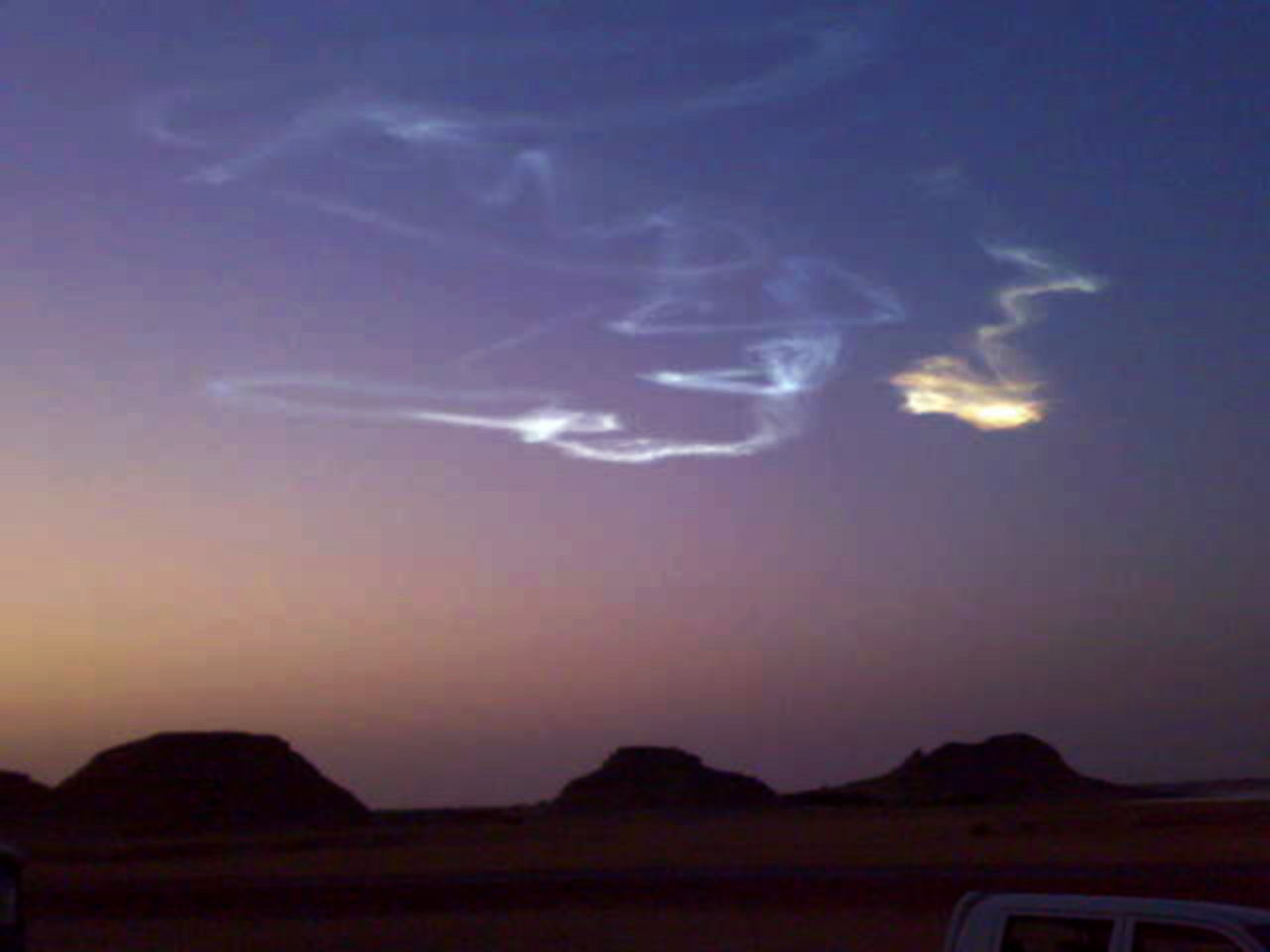
First ground-based evidence of 2008 TC3's meteoric fall
Last month, 2008 TC3 became the first asteroid to hit the Earth after astronomers had predicted it would. Of course, it was small enough (6-10 feet) that it is believed to have mostly burned up in the atmosphere. Indirect evidence of this meteoric fireball was caught by an infrasound microphone in Kenya, a security camera in Egypt, a weather satellite, and an airline pilot. Now, we have images from Sudan of the smoke trail. For the full story, click here.
2008-08-27
2008-08-14
The Pending Disappearance of Pluto (1980)
Today I tuned in to The Great Planet Debate, which finally spurred me to my first post to this new blog. As part of a greater "scientific conference and educator workshop" at Johns Hopkins, Neil deGrasse Tyson took on Mark Sykes in a webcasted debate about Pluto and the definition of the word "planet". It was pretty entertaining! (Not at all like I imagine the 1920 Shapley-Curtis Debate about the size of the Universe went down, but I'm still waiting for them to post that webcast online.) It also provided nice exposure to the public about what science is and is not (or should not be). I recommend that you check it out, once the full webcast is posted at the above site (in the next 2 weeks).
In the course of the debate, they brought attention to an article that appeared in the journal Eos in 1980, called "From the Ridiculous to the Sublime: The Pending Disappearance of Pluto." It turns out that in 1848, the estimated mass of the not-yet-discovered Pluto was about 12 times the mass of the Earth. A number of renowned astronomers weighed in on the matter over the following century, revising the estimate downward. The decline was slow at first but by the 1970s, its mass was dropping at an alarming rate! Taking all of these renowned astronomers seriously, Dessler and Russell forecast that Pluto would disappear entirely by the year 1984. (But it would return! Read on if you're interested...)

Ah, science! This reminds me, I should try to find the old-old journal article about determining the color of Mars by comparing it with paint samples.
Subscribe to:
Posts (Atom)